HVAC Training for Professionals
Air
Conditioning and Refrigeration Training
for
|

FREE HVAC-R Tips Newsletter
We HATE Spam, Too and Would Never Share Your Information. Refer to Our Privacy Policy.
Here's Our Favorite HVAC Training Program
(Not Free, But Worth Every Penny)
Great Special Bonuses Just Added!
Plus Free Shipping!


Animated Graphics
Easy To Understand Concepts
Not like those BORING Text Books!
Start Having Some Fun Learning!

Interactive Training Course
We used this very same software training program
at our Air Conditioning School in Texas
Click Play to Watch this Short Video
Use Your
Meters,
Gauges
and
Thermometers
to
Diagnose
the
Problems
You Can't Lose With
Our 100%, Iron-Clad, Money-Back Guarantee! "Your satisfaction is
guaranteed with our 100%, no-questions
asked, iron-clad money-back guarantee. If
you aren't absolutely thrilled with our
product just send it back to us within 60
days and we'll refund 100% of your purchase
price. No questions asked."
Get this
Brazing
and
Soldering
DVD as a
Free
Bonus
Gift
Today
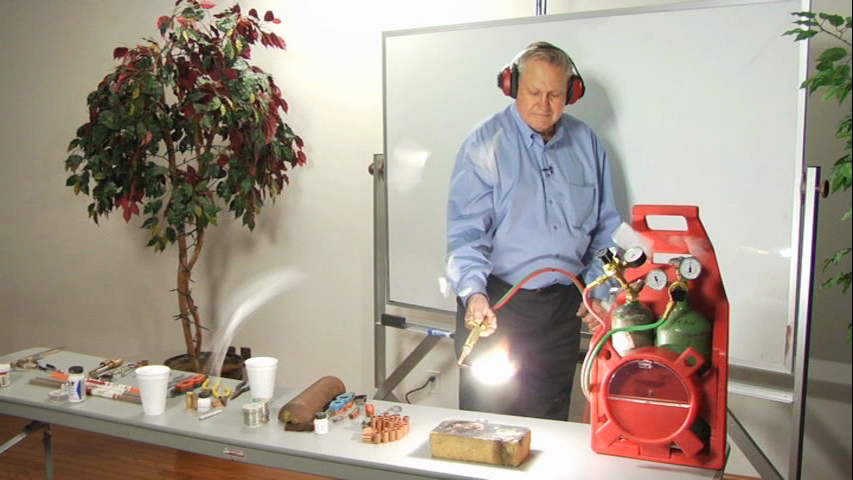
FREE BONUS GIFT #1
"Everyday Options for
Soldering & Brazing"
DVD
with
Carl Pollex - Industry Legend and Instructor
Oxygen Acetylene
Safety
Brazing
Soldering Free With
Refrigeration Basics III Interactive HVAC Training
Course - Only From
Us!
FREE BONUS GIFT #2
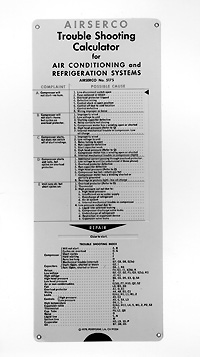
Trouble Shooting Calculator
This calculator simplifies the job of
diagnosing cooling system troubles. Ideally suited
to the needs of the expert as well as of the needs
of the trainee, it provides immediate reference,
from COMPLAINT to POSSIBLE CAUSE to REPAIR.
Yours Free Free With
Refrigeration Basics III Interactive HVAC Training
Course - Only From
Us!
FREE BONUS GIFT #3
A/C
Troubleshooting Guide An Excellent Collection of
Training Files in PDF Format
Yours Free!
What people are saying about
Refrigeration Basics .... To those in the know: I am a student in the 1.5 year HVAC Associates
Degree Program at Redstone College in Broomfield,
Colorado. While browsing the web for more "easier to
understand" information on refrigeration and
heating, I stumbled upon the Refrigeration Basics
III Interactive Training CD. I immediately purchased
the CD and it has been well worth the investment! The photo links, easy to understand dialogue and
clever animation make the course material fun to
learn. One of the drawbacks to typical HVAC-R
textbooks is that they are frequently too
complicated in their explanations and terminology. The Refrigeration Basics III CD is exceptional in
its ability to explain complicated systems,
definitions, and the processes that go along with
refrigeration and heating. The troubleshooting
guides and schematics really help the student to
test his or her knowledge with real world
simulations. Do yourself a favor and fork out the $$$ to get
this product. It will be an asset and handy
reference too for you in the future!
Scott M. - Broomfield, Colorado I just received the
Refrigeration Basics III Professional Version
from you guys and I just wanted to say thanks for
all of the great work that you did on this. I work
in engineering at a Rehab Institute and I can see
this is going to help a lot in my understanding of
everything from ice makers to walk-in refrigerators
to heat pumps. Everything from the theory to the
troubleshooting parts are terrific! I was showing the roof top
unit troubleshooting to a friend, who is a licensed
HVAC service tech, and it had him stumped for a
while. He said he is going to order a copy for
himself! Lawrence H.. - Spokane
Washington
Steve, This CD is awesome!! Very well thought
out and makes learning AC a breeze! My hat is off
to you for making a great learning tool available.
Hope the heating CD is just as good and let me know
when it becomes available. If you have any info on
the EPA exam, what books I need, or best study
material please let me know.
Thanks again,
Charles E. - Canton, Mississippi
|
Limited Time Special Offer! Save $$ Today |
|

Only $239
Save $60
Free Shipping!
|
You Can't Lose With Our 100%, Iron-Clad, Money-Back Guarantee!
|

HVAC Training Starts With The Basics......
\
© 2001-2003 Seaside Computing
The latter two are used extensively in the design of refrigeration equipment. If you place two objects together so that they remain touching, and one is hot and one is cold, heat will flow from the hot object into the cold object. This is called conduction. This is an easy concept to grasp and is rather like gravitational potential, where a ball will try to roll down an inclined plane. If you were to fan a hot plate of food it would cool somewhat. Some of the heat from the food would be carried away by the air molecules. When heat is transferred by a substance in the gaseous state the process is called convection. And if you kicked a glowing hot ember away from a bonfire, and you watched it glowing dimmer and dimmer, it is cooling itself by radiating heat away. Note that an object doesn’t have to be glowing in order to radiate heat, all things use combinations of these methods to come to equilibrium with their surroundings. So you can see that in order to refrigerate something, we must find a way to expose our object to something that is colder than itself and nature will take over from there. We are getting closer to talking about the actual mechanics of a refrigerating system, but there are some other important concepts to discuss first.
They are of course; solid, liquid and gas. It is important to note that heat must be added to a substance to make it change state from solid to liquid and from liquid to a gas. It is just as important to note that heat must be removed from a substance to make it change state from a gas to a liquid and from a liquid to a solid.
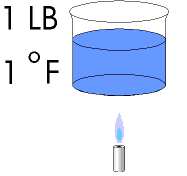
Long ago it was found that we needed a way to quantify heat. Something more precise than "less heat" or "more heat" or "a great deal of heat" was required. This was a fairly easy task to accomplish. They took 1 Lb. of water and heated it 1 degree Fahrenheit. The amount of heat that was required to do this was called 1 BTU (British Thermal Unit). The refrigeration industry has long since utilized this definition. You can for example purchase a 6000 BTUH window air conditioner. This would be a unit that is capable of relocating 6000 BTU's of heat per hour. A larger unit capable of 12,000 BTUH could also be called a one Ton unit. There are 12,000 BTU's in 1 Ton.
To raise the temperature of 1 LB of water from 40 degrees to 41 degrees would take 1 BTU. To raise the temperature of 1 LB of water from 177 degrees to 178 degrees would also take 1 BTU. However, if you tried raising the temperature of water from 212 degrees to 213 degrees you would not be able to do it. Water boils at 212 degrees and would prefer to change into a gas rather than let you get it any hotter. Something of utmost importance occurs at the boiling point of a substance. If you did a little experiment and added 1 BTU of heat at a time to 1 LB of water, you would notice that the water temperature would increase by 1 degree each time. That is until you reached 212 degrees. Then something changes. You would keep adding BTU's, but the water would not get any hotter! It would change state into a gas and it would take 970 BTU's to vapourize that pound of water. This is called the Latent Heat of Vapourization and in the case of water it is 970 BTU's per pound.
© 2001-2003 Seaside Computing
You Will Learn the Basics with Easy to Understand HVAC Training Lessons.
Then You Will Learn Advanced HVAC Troubleshooting Skills
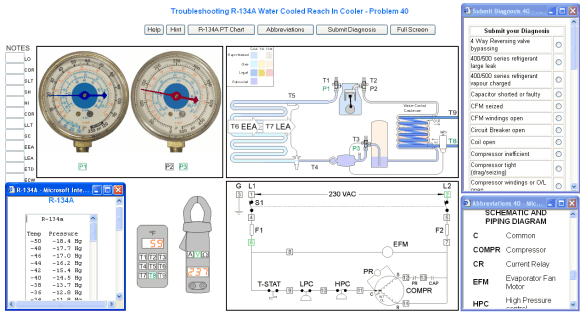
with 100 Simulation Boards Like This One....
© 2001-2003 Seaside Computing
Use Your Meters, Thermometers and Gauges to Diagnose
Real-World HVAC Problems..
Very Challenging !! And Fun !!
Get Started Becoming a Professional HVAC Troubleshooter Today!
Why I Became a Distributor for Refrigeration Basics
It is written from a HVAC technician's perspective and easy to understand. The large, animated and interactive graphics make learning fun.
Our students and instructors loved the program so much that we included it into our training programs at HVAC Training Center, Inc., as well as in our online training programs.
I absolutely had to become an official distributor for the program.
Steve Carver - Co-Founder of HVAC Training Center, Inc., President of LearnAC.com and AcTecHelp.com.
Only
$239
Save $60
Free Shipping!
Here are Some of the Topics Covered in the
Refrigeration Basics Interactive HVAC Training Course
HVAC Training Index
3 Phase 4 way reversing valve AB Absolute Zero AC access valves accessories accumulator Accurator Add On Heat Pump adiabatic AEV AFUE AHU air (components of) Air Conditioning air (conditions of) air filtration alkylbenzene oil All Electric Heat Pump Alternating Current amperage, also Annual Fuel Utilization Efficiency anti-short-cycling device anticipation ASHRAE atom Automatic Expansion Valve Azeotrope Back Seated Balance Point barometer bi-metal disk Bourdon Boyle's Law British Thermal Unit BTU bull headed tee burn outs capacitor Capacitor Start Capacitor Run Motor Capacitor Start Induction Run Motor capillary line Celsius centrifugal compressor ceramic capacitor charging Charle's Law check valve Close Coupled Class 1 conversion Class 2 conversion coalescing oil separators compressors compressor driver Compressor Efficiency Test condensate line condensate pan Condenser Dampers condensing medium Condensing Unit conduction (electrical) conduction (thermal) conductor (thermal) controls Constant Cut In Control convection cooling anticipation cooling load cooling tower COP, also Coulomb CPRV cracked crankcase heater CSIR CSCR current relay cut in cut out Daulton's Law DC Defrost Termination Thermostat design temperature Dew Point Defrost Termination Stat dielectric Direct Current Discharge Service Valve discharge temperature distributor drop in replacement DSV EER EEV electric defrost Electro-Magnetism electrolytic capacitor Electromotive Force Electronic Expansion Valve EMF energy Energy Efficiency Ratio enthalpy enthalpy controls entropy EPRV evacuation, also Evaporative Condenser Fahrenheit fan cycling Fan Delay Thermostat fan rotation fan speed controller filters (air) filters (refrigerant) Fixed orifice flash gas flammability Fresh Air Free Cooling front seated gases Gas Laws gauge gauge manifold set Hand Operated Expansion Valve hand valve Head Pressure Control heat heat anticipation Heat of Compression Heat Pumps Heating Seasonal Performance Factor helical oil separators HEPA hermetic compressor Hertz High Side Float High Side Restriction holding circuit Hop Scotch Method (troubleshooting) Hot Gas Bypass Regulator hot gas defrost Hot Wire Relay HSPF
HVAC Training Basics
HVAC Training Advanced
HVAC Training - Troubleshooting Electrical
HVAC Training - Troubleshooting Mechanicalhygroscopic hydrostatic pressure human comfort zone humidity impedance impingement oil separators incremental unit insulation (electrical) insulation (thermal) Kelvin King Valve Latent Heat ladder schematic lead-lag Line Tap Valve liquid/vapour interface Liquid Line Filter/Drier Liquid Line Solenoid Valve liquid slugging LLSV lock out circuit Locked Rotor Amperage Low Side Float low voltage controls LRA magnetism MAT Mechanical Cooling MegOhm Mercury mercury bulb thermostat Metering Device MFD micron micron gauge Mid Seated migration mineral oil Minimum Fresh Air Mixed Air MO molecule Mollier Charts motor theory motor types muffler multiple stages Non-Recycling Pump Down OAT ODS ODS conversions OEM off cycle defrost Ohm Ohm's Law oil failure controls oil separator oil slugging open compressor ORD ORI OROA Ozone Depleting Substance Packaged Systems PAG Parallel Drop Permanent Split Capacitor Motor phosgene piping POE polyalkylglycol oil polyolester oil potential relay pressure pressure control Pressure-Enthalpy Diagrams Pressure Temperature Relationship PSC PSIG Psychometrics P-Trap PTC PT Charts PTCR pump down Radiation Rankine receiver reciprocating compressor reclaim recover recycle refractometer refrigerant leaks refrigerant oils refrigerants Refrigerant Side Head Pressure Control Refrigeration (definition of) Refrigeration loop relay resistance retrofitting ODS reuse reverse cycle defrost rotary compressor rotor run capacitor running burn out safety safety controls saturated conditions Schraeder Valve screw compressor scroll compressor Seasonal Energy Efficiency Ratio Secondary Refrigerant SEER semi-hermetic compressor Sensible Heat Service Valves set back Shaded Pole Motor short cycling sight glass Specific Heat Split Phase Motors Split Systems Squirrel Cage Start Capacitor stator Subcooling Suction Cut-Off suction filter suction/liquid heat exchanger Suction Service Valve Superheat SSV tackifed Temperature TEV TD (Temperature Difference) Thermal Starting Relays Thermostatic Expansion Valve thermostat - low voltage three phase motors time delay fuses time delay relays Ton toxicity transformer troubleshooting TXV unloader vacuum vibration absorber vibration loop voltage wall mounted thermostats water cooled condensers water cooled system water regulator valve Zeotrope
You Can't Lose With Our 100%, Iron-Clad, Money-Back Guarantee!
"Your satisfaction is guaranteed with our 100%, no-questions asked, iron-clad money-back guarantee. If you aren't absolutely thrilled with our product just send it back to us within 60 days and we'll refund 100% of your purchase price. No questions asked."
FREE BONUS GIFT #1
"Everyday Options for
Soldering & Brazing"
DVD
with Carl Pollex - Industry Legend and Instructor
Oxygen Acetylene Safety
Brazing
Soldering
Free With Refrigeration Basics III Interactive HVAC Training Course -
Only From Us!
FREE BONUS GIFT #2
Trouble Shooting Calculator
This calculator simplifies the job of diagnosing cooling system troubles. Ideally suited to the needs of the expert as well as of the needs of the trainee, it provides immediate reference, from COMPLAINT to POSSIBLE CAUSE to REPAIMechanical Refrigeration R.
- 19 major ‘Complaint’ sections
- 32-part ‘Trouble Shooting’ Index
- 127 ‘Possible Cause’ items
- All items keyed to ‘Repair’ window
Yours Free
Free With Refrigeration Basics III Interactive HVAC Training Course -
Only From Us!
FREE BONUS GIFT #3
A/C Troubleshooting Guide
An Excellent Collection of Training Files in PDF Format
Yours Free!
You Can't Lose With Our 100%, Iron-Clad, Money-Back Guarantee!
"Your satisfaction is guaranteed with our 100%, no-questions asked, iron-clad money-back guarantee. If you aren't absolutely thrilled with our product just send it back to us within 60 days and we'll refund 100% of your purchase price. No questions asked."
Only
$239
Save $60
Free Shipping!
Privacy Policy About Us Contact Us
------------------------------------------------------------------------------------------------------------------------------
Some Basic HVAC Training Information
Mechanical Refrigeration Back to Life - 3 Level Healthy Back System Review Puravive His Secret Obsession Review Liv Pure Review Unlock Your Hip Flexors by Rick Kaselj Old School New Body Review Mend The Marriage The Ex Factor Guide Reba Sloan Basic Electricity Thermodynamics
More HVAC Training Information
---------------------------------------------------------------------------------------------------------------------------------------------------------
LearnAC.com - 1341 W. 43rd Street - Suite 235 - Houston, TX 77018 - (713) 481-0781 Email Us
Sample lesson text and graphics © 2001-2003 Seaside Computing and may not be copied or duplicated.